The Palace at the Center of the City
One significant landmark in Chiyoda Ward is the Imperial Palace. It sits in the middle of Tokyo and acts as a sort of island-like respite from the chaos of the rest of the city. Flush with greenery, the structures within Chiyoda Ward juxtapose the concrete urban environment that surrounds it, likening it to a “beating heart.” Moats and parks separate the palace structure from high-rise apartments and office buildings that decorate the surrounding Marunouchi financial district. Roads radiating around the park draw the eye, allowing the palace and its gardens to not only sit at the center of the city, but be a centerpiece.
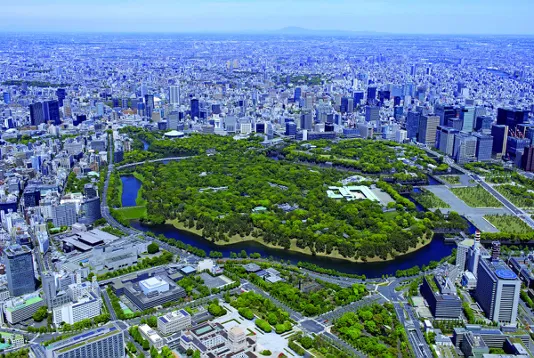
As Maya Chawla from Architectural Digest notes, Japanese architecture “has always been rooted in simplicity, harmony, and a close connection to nature.” The Imperial Palace clearly exemplifies this. The structure is low-rise, allowing it to harmonize with the surrounding natural environment. As shown by the bird’s-eye view of the city, the palace is hardly discernible from the trees that surround it. Rather than dominating the city through verticality or grandeur as other imperial homes do—the opulence of the Forbidden City in Beijing and Palace of Versailles in France come to mind—the Tokyo Imperial Palace dominates by asserting deference from neighboring structures.
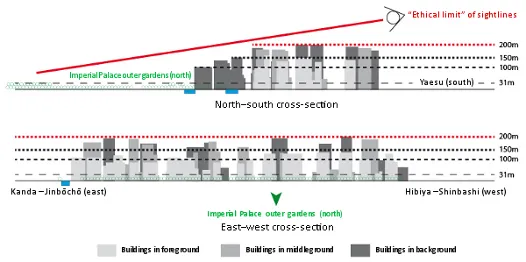
Raphaël Languillon-Aussel notes that the Marunouchi skyline forms a gradient where building heights decrease moving towards the Imperial Palace. Aussel continues that this is out of convention: “Long considered a living god, the Emperor was invisible and untouchable…the city is ‘prostrating’ itself in a sort of reverential bow.” Thus, the Imperial Palace and its gardens demand respect from the rest of the city based on the legacy, imperial power, and symbol of the Emperor represented by the palace. Chiyoda Ward serves as a center for relaxation, a passive portrayal of power among the teeming streets of Tokyo.