2a. How can SEFC prioritize social equity and livability to continue to address gentrification and the resulting housing crisis in Vancouver?
SEFC aims to address issues such as the housing crisis by emphasizing affordability and economic viability, walkability, and recreation in order to further social equity and livability. This is highly emphasized throughout the ODP, Policy Statement, and Public Realm Plan.
Throughout the ODP, there is a large focus on the development of affordable housing, specifically, “dwelling units designed to be affordable to persons who make up a core need household where such persons pay more than 30% of their combined gross annual income to rent” (City of Vancouver, 2024, p. 5). This shows the centrality of social equity in SEFC because it has a large focus on ensuring that people of all income levels can afford housing. Further on in the plan, the City outlines an intent to ensure at least 20% of housing is affordable, with a goal of 33% (p. 16). This shows an upward mobility, an intention to continue to expand the scope of affordable housing, which is important given the rising cost of housing throughout the city. In all, they aim to create a balance of housing that accommodates “a full range of age and social groups, and household types and needs” (p. 17). By specifically focusing on accommodating people of all social groups, SEFC can work to reduce the harm of gentrification and the housing crisis by ensuring that people already living in these neighborhoods can still afford to live there. The Policy Statement further outlines principles of livability (City of Vancouver, 1999, p. 5) and social and community health (p. 80) that seek to provide accessible housing and ensure the well-being of all residents.
The City also shapes SEFC around economic viability. It intends to create opportunities for employment and investment “through the construction process…the operation of retail, service, and office uses…providing quality, licensed child care to allow parents to participate in the labour force; and encouraging the construction process to promote equitable hiring practices, and to ensure the representation of unemployed members of low-income communities,” as expressed in the ODP and Policy Statement (City of Vancouver, 2024, p. 19; 1999, p. 80). This ensures that people who live in these neighborhoods can continue to afford to do so, while also ensuring that the area is accommodating to newcomers. By centering economic opportunities, SEFC can expand the community in a sustainable way. The larger emphasis on equitable housing practices can cement livability and social equity by ensuring that even those in the most vulnerable groups have access to jobs. The Policy Statement similarly envisions “housing that is well linked by transit to nearby jobs” (City of Vancouver, 1999, p. 7).
These documents also emphasize accessibility and the ability to navigate throughout the neighborhoods without relying on an automobile. The ODP outlines plans to pedestrianize all of the streets in the SEFC neighborhood, implementing walking and bike paths to connect public areas and “promote movement toward the waterfront.” These paths will be lined with trees and buildings that are low enough for “street-level sunshine” (City of Vancouver, 2024, p. 29). According to the Policy Statement, SEFC will be a “complete community with goods and services within walking distance” (City of Vancouver, 1999, p. 7). Parks, health clinics, childcare, and access to fresh food are also highly emphasized in the ODP.
Finally, SEFC prioritizes social equity and livability through the implementation of amenities such as parks and plazas. The ODP looks at encouraging social interaction through the creation of green spaces, plazas, farmers markets, spiritual centers, and community centers (CITATION). The Public Realm Plan similarly emphasizes clustered community services (CITATION, p. 9). Thus, it is clear that ensuring social equity through emphasizing affordable housing, economic opportunity, accessibility, and recreation are important goals for SEFC planning.
2c.1. What does SEFC planning, design, development, and engineering show about contemporary city-making?
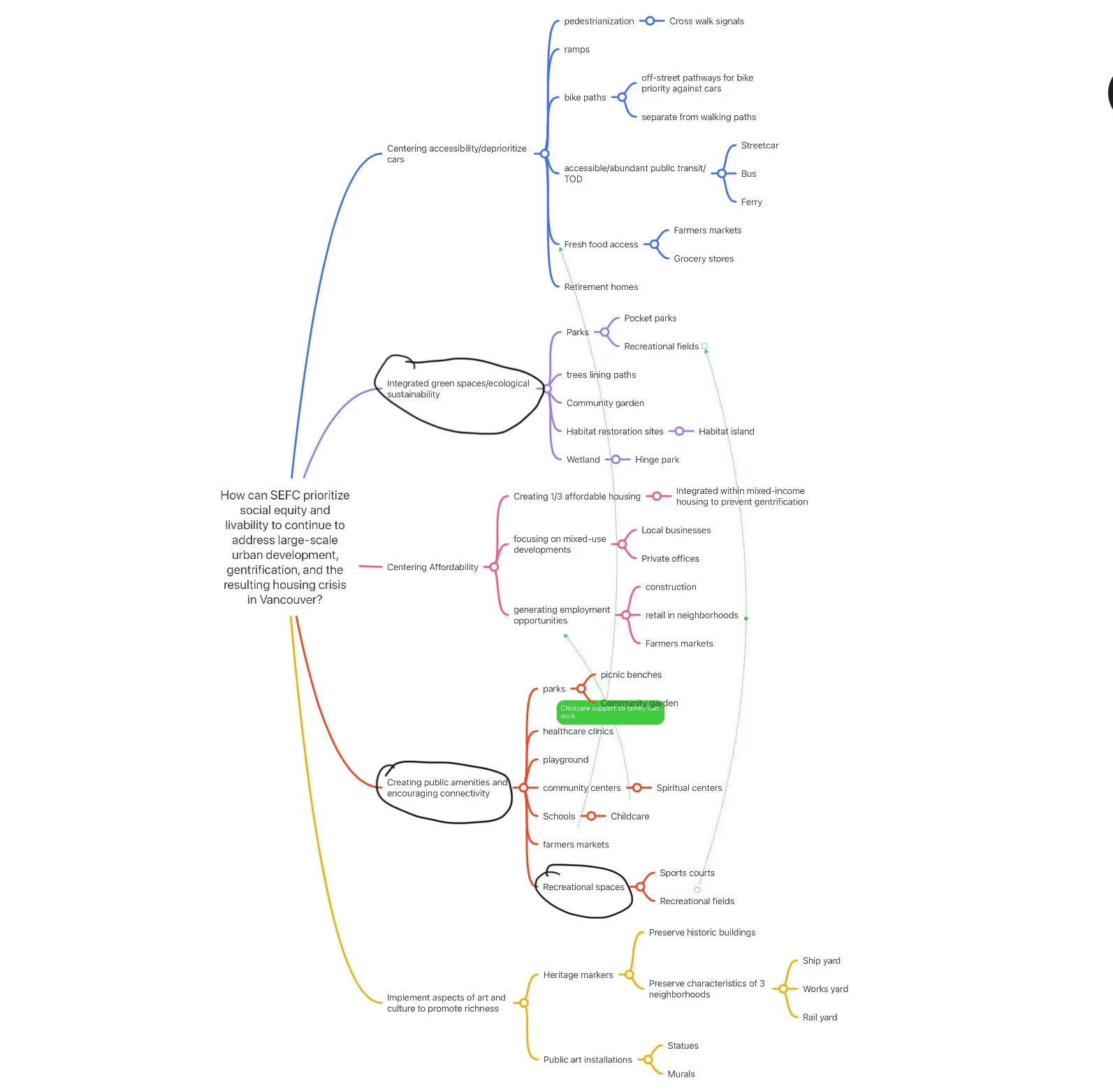
The SEFC planning, design, development, and engineering shows me that contemporary city-making can be especially effective at changing the connectivity and environment of a community.
Through the creation of amenities such as parks, community gardens, playgrounds, and community centers, SEFC is able to create a thriving and rich set of neighborhoods that facilitate community engagement and sustainability. These tools are the most transformative because they encourage those of all social groups within the community to come together and interact. Additionally, these, alongside other green installations, further the goal of ecological sustainability within the area.
For example, Hinge Park in SEFC is an active wetland that can help sequester carbon, filter water, provide ecological support, and promote biodiversity. It is also a large space that can be utilized for recreation and leisure. Children play in the playground, people walk their dogs, and others help steward the community garden. All of these activities foster instances of spontaneous interaction, furthering connectivity within the community and catalyzing the creation of culture and camaraderie. The ODP emphasizes fostering certain “personalities” for each neighborhood and for the region as a whole. The development of community amenities that develop culture helps position SEFC as a place that values social equity and sustainability.
Implementing green spaces also helps improve the aesthetics of the city, contributing to the well-being of residents. Similar to ideas in the City Beautiful Movement, green space and intentional landscaping can allow people to enjoy their commute more while also beautifying the area. An important part of city-making is ensuring that cities are places people can find beauty and pleasure in. Thus, parks, gardens, and other community amenities can create visual excitement within the concrete jungle of the broader city, improving the health and well-being of residents in the area.
2b.2. What are the limitations of contemporary city-making in SEFC?
The SEFC planning, design, development, and engineering shows me that contemporary city-making can be especially limited by attempts at increasing density while also balancing the costs of building homes and maintaining the land.
Attempts at creating more housing in the SEFC area come with side effects of infringing on the area’s core goal of mixed-income housing and also create monetary risks. SEFC has long set out a plan for creating an abundant mélange of low-, middle-, and high-income housing. While more housing is necessary to expand the scope of residents in the area, land costs are well over the costs to even begin building housing. In tandem, infrastructure would also have to be adjusted to account for the increase in population in the area. As a result, creating permanently affordable housing—as the original plan entails—is an extremely gargantuan task.
The fluctuating costs of land cannot be confined through city-making but are globally driven processes that transcend spatial limits. Thus, being able to create more housing and increase density is hard to control. In order to generate revenue, housing that caters to the upper class may be prioritized; people will pay more for views of the waterfront and the skyline. However, this would further push SEFC away from mixed-income housing. The 2021 plan outlined efforts to densify farther from the waterfront, preserving houses closer to the water for those who will pay more. Thus, housing becomes segregated by income, as dense housing farther away from the water and closer to downtown becomes the affordable option for those in the lower- and working-class groups.
This deviates from goals related to social equity and resilience in the face of gentrification in the broader Vancouver area. While aspects of city-making can encourage social equity through implementing accessible community amenities, the question of housing (which some argue is the most central to achieving social equity at all) persists as the affordability crisis deepens.
2c.3. How does this image show the relationship between industrial city-making and contemporary sustainability goals?
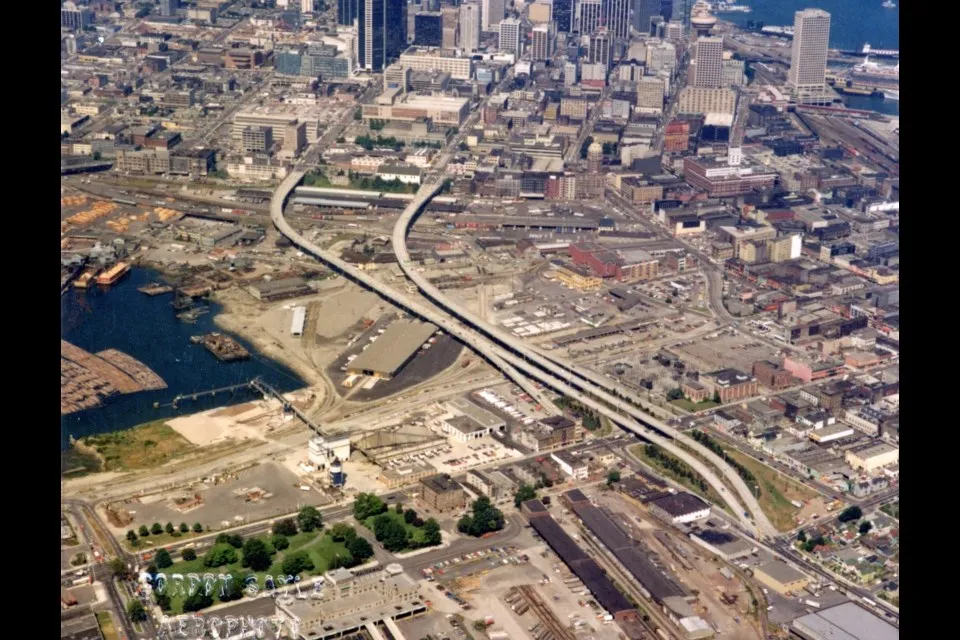
This image shows how industrial city-making influenced contemporary sustainability goals because it portrays the implementation of key infrastructure within cities to promote the well-being of residents and further goals of sustainability by expanding public transportation.
This image portrays the expansion of key transportation infrastructure, including the SkyTrain. Additionally, further roadways and parking lots were built to accommodate cars and expand the scope of movement throughout the city. In City Worlds, Steve Pile emphasizes the importance of new transportation technology in expanding the market of Chicago and transforming it into a city. Transportation created a way for goods to move around faster and farther, and for people to get around more quickly.
The development of the SkyTrain created more density in Vancouver, allowing the city to accommodate more people and allowing more access to opportunity. Suddenly, the breadth of movement for people who did not have access to cars expanded. Public transit is also a more accessible option, as those who cannot afford cars can utilize it to traverse the city. Public transportation is additionally important for sustainability because it lowers the number of automobiles on the roads, reducing emissions.
Though early efforts toward city-making centered on automobiles, the creation of public transportation has been very important for following contemporary sustainability goals. The SkyTrain resulted in mixed-use developments along train lines and continues to promote walkability, reducing congestion within the city. The SkyTrain not only expanded access to opportunity in Vancouver but also created opportunity by spurring the creation of businesses along the line. These businesses create more employment while also benefiting from the increased density and mobility that the SkyTrain provides.